The world of science and technology is replete with mysteries and challenges. In fundamental science, the nature of dark matter is a mystery that has kept scientists on their toes for decades. Is it a cloud of particles surrounding all the galaxies? And if these particles were produced in the Big Bang, could we produce them by recreating a miniature version of Big Bang at the Large Hadron Collider?
In the field of technology, computer vision is a fascinating challenge. How does the brain identify objects in an image? Can we understand and mimic this logic using artificial intelligence?
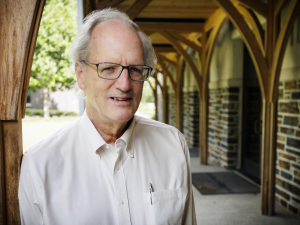
Ashutosh Kotwal, Fritz London Professor of Physics at Duke University, melds both mystery and challenge with a possible solution. In a recently published paper in Nature Scientific Reports, Kotwal proposes a novel algorithm for the task of image segmentation, the crucial first step in computer vision.
In any large image containing multiple objects, the image must first be split up into regions or windows such that each window contains an object of interest. Object recognition can then be performed on each window.
Kotwal shows that his strategy can also be applied for high-speed analysis of proton-proton collision events at the Large Hadron Collider (LHC). There, the experimental apparatus uses three-dimensional silicon sensors to record digital images of tens of thousands of particles at the rate of 40 million “snapshots” per second. Kotwal's new scheme can parse this vast amount of data into fixed-size segments, such that all particle trajectories of interest are contained in at least one segment.
In his previous papers, Kotwal has shown how these particles can be identified in each segment. Using his new research, should any of these particles decay to dark matter, they will be caught in the act in real time. This would be unambiguous evidence for the production mechanism of dark matter particles.
Kotwal's algorithm is a great example of cross-pollination between different fields of physics. In the late 1960s, Leo Kadanoff developed the concept of grouping fixed numbers of elementary constituents into larger blocks having self-similar properties. The idea became a cornerstone of physics. Kotwal has adapted the concept to computer vision by grouping the primitive elements of an image into fixed-size sets that follow certain rules. He shows how the task of finding objects in these blocks no longer depends much on the size of the grouping.
Kotwal is now working with Duke undergraduate students to implement this algorithm directly in a silicon chip, so that it can operate at the speed of tens of nanoseconds and keep up with the LHC data rate. He is also planning to expand the scope of the project to include other applications in computer vision. He believes his algorithm is particularly suited for segmenting images containing many small objects, a situation that presents difficulties for other computer-vision algorithms.
#
CITATION: Kotwal, A.V. Block segmentation in feature space for realtime object detection in high granularity images. Sci Rep 15, 34549 (2025). https://doi.org/10.1038/s41598-025-17888-0