

The photo above is an image taken by the Hubble Space Telescope of a nearby spiral galaxy with a globular cluster marked and enlarged.Jay Strader, ’02, was an economics and math major when he took an astrophysics course as a sophomore. The course, taught by former Duke professor John Kolena, captured his imagination in a way economics never had, and a summer research project related to old massive star clusters convinced him to drop the econ major and replace it with physics (he kept the… read more about Jay Strader, Hubble Fellow at the Harvard-Smithsonian »
NOTE: LINKS HAVE BECOME BROKEN DUE TO SITE REDESIGN Duke Physics' Graduate Curriculum Committee adopted a new Graduate Program curriculum in October 2009. This committee, composed of faculty members and graduate students, conceived of an exciting redirection of the graduate program that offers incoming students the ability to focus on their own research while taking challenging courses. Read details on the new curriculum at the Duke Physics website. read more about New Curriculum in Graduate Program »

Josh Albert, a fourth-year graduate student at Duke, recently returned from another trip to a high energy physics experiment in Japan. "The travel is fascinating," Albert says. "Not just from a physics perspective but also because I'm able to meet people with such different perspectives." High energy physics experiments are massive endeavors, requiring teams of hundreds or thousands of physicists from dozens of countries. Graduate students and undergrads at Duke are active participants in these… read more about High Energy Physicists as World Travelers »
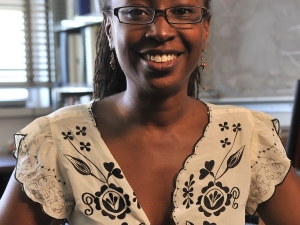
The physics department’s newest faculty member, Ayana T. Arce, earned her PhD at Harvard, did a Chamberlain post-doctoral fellowship at Lawrence Berkeley National Laboratory, and is thrilled to have settled at Duke. As a high energy experimental physicist, Arce has worked with a lot of different physics departments at Fermilab and the Large Hadron Collider. “Each department has their own flavor,” she says. “High energy physics at Duke has got a perfect combination of energy and healthy collegial spirit.”… read more about Ayana Arce: HEP's Newest Faculty Member »
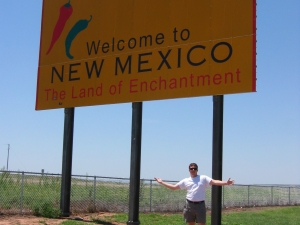
Why Duke Physics? A Photo Essay on the Strengths of DukeThe collage below is a selection of our ongoing photo essay called "Why Duke Physics?" This project, hosted at both Flickr and Facebook, collects quotes and images that cover the variety of aspects that draw students to the Duke Physics Department. What better way to highlight our strengths than to ask members of the Duke Physics community? Become a Fan of Duke Physics on Facebook Duke Physics is now on… read more about Connect to Duke Physics on the Web! »
NOTE: LINKS HAVE BECOME BROKEN DUE TO SITE REDESIGN Students who have been accepted to the Duke Physics graduate program are just now finding congratulatory emails in their inboxes. Many of you alumni will remember the feelings of excitement when choosing to attend Duke. This issue highlights the diverse experiences in physics research available at Duke. These strengths come from cutting-edge faculty, state-of-the-art research facilities, a strong global presence, and an enriching graduate community. Our… read more about Welcome to the February Duke Physics Newsletter »
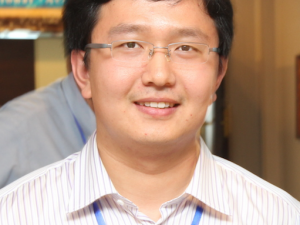
Xin Qian, a graduate student in Prof. Haiyan Gao’s Medium Energy Physics Group, is the winner of the 2010 Caltech Prize Fellowship in Experimental Physics or Astrophysics. The Fellowship is highly competitive. For the fall of 2010, Xin Qian is the only candidate in the world who has been awarded this prize Fellowship. According to the Fellowship webpage: "This Fellowship program has been established to offer scientists, typically within a few years after receipt of the Ph.D., the… read more about Xin Qian Wins 2010 Caltech Postdoctoral Prize Fellowship »
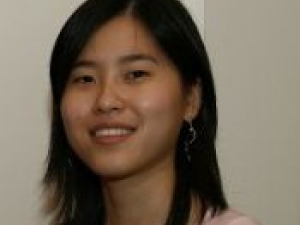
In Memoriam - Daphne Y. Chang (Trinity 2005), a Duke Physics major, passed away on December 21st after battling a never fully diagnosed disease on and off for the past two years. She was 26 years old. Daphne will be remembered by the Duke Physics community as an extraordinary person: in her sophomore year she joined the Nuclear Theory Group as an independent study student. Her subsequent research under the supervision of Prof. Steffen A. Bass on the production of strange quarks in relativistic heavy-ion… read more about Daphne Chang Memorial Award Fund »
Duke professors Berndt Mueller and Steffen Bass are playing leading roles in a multi-institutional team that was recently awarded Department Of Energy (DOE) funding for a Topical Collaboration on "Jet and Electromagnetic Tomography in Heavy-Ion Collisions." The JET Collaboration, which includes theorists from eight institutions in the U.S. and Canada, was among the first three topical collaborations in nuclear theory to be awarded in this new program of the DOE Office of Science. Mueller… read more about Profs. Mueller and Bass awarded Topical Collaboration Grant »
Duke Physics is now on Facebook and Filckr, a photo sharing community. These sites provide new ways of connecting to the Duke Physics community of professors, alumni, students and physics-enthusiasts around the globe. Click on either image to see our activities on the web. Most of the photos on Flickr are submitted by members of the Duke Physics Community. Do you have photos you'd like to share? There are two easy ways to share your photos:Submit images directly to our Flickr page in an email to "… read more about Connect to Duke Physics on the Web! »
NOTE: LINKS HAVE BECOME BROKEN DUE TO SITE REDESIGN We have added two new sections to the Duke Physics News Site: Duke Physics In the News is a collection of notes referring to mentions of Duke Physics in the media, and Department Achievements is a list of brief news items about people from the department. read more about Duke Physics In the News & Department Achievements »
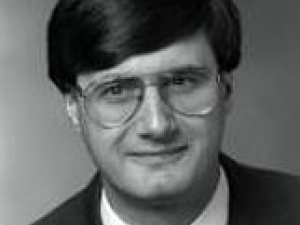
Prof. Daniel Gauthier (Duke Physics) and Prof. Robert Boyd (Institute of Optics, University of Rochester) have just been awarded a grant to study quantum communication protocols that encode information in the transverse profile of an optical beam. Specifically, they are investigating encoding information in the orbital angular momentum degrees of freedom of a beam, with the goal of reliable transmission of more than one bit of information per photon. Also, they are investigating whether these protocols are… read more about Faculty Research Update - Gauthier and Boyd receive Grant for Quantum Communication Study »
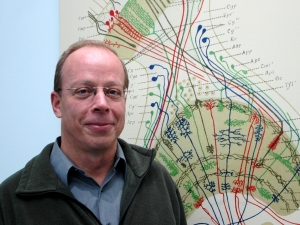
Duke Professor Henry Greenside is a theoretical physicist who studies how the brain works. He says, “The brain is so complicated we need to approach it from various angles. The thing a physicist brings to bear is the belief that if you push hard enough there will be some understanding. Physicists use theoretical and mathematical tools and we’ve repeatedly found concise mathematical descriptions of very complicated things.” Greenside spent the fall term on sabbatical at Janelia Farm, the research campus of… read more about Faculty Research Update - Physicist as Brain Scientist »
As a graduate student at TUNL, Scott Wilburn '93 made precision measurements with neutrons in order to study the interactions of polarized neutrons and polarized protons. Today, he’s using similar techniques at the Los Alamos National Laboratory in New Mexico, but with lower-energy neutrons, and with a different goal. “I’m using the neutron as a laboratory to look for new physics beyond the standard model,” he says. “The neutron decay process is interesting to look at because you can do both very precise measurements and… read more about Alumni Profile - Scott Wilburn at Los Alamos National Laboratory »

Professor Mark Kruse spent November 29-December 3 at the Large Hadron Collider at CERN in Geneva. “The atmosphere there is pretty incredible right now,” he says. “Everyone’s getting very excited. The beam is circulating and they’ve managed to produce proton-proton collisions in the last few days—at a lower energy than designed, but still a huge milestone toward that goal.” Now that the LHC is operational again, thousands of scientists, engineers, and students have converged on the place. “There are… read more about Department Research Update - Duke Physicists at the LHC »

NOTE: LINKS HAVE BECOME BROKEN DUE TO SITE REDESIGN With this issue we are announcing Duke Physics' new online presence on what some term "the social web" - the collection of websites (like Facebook, Flickr, and LinkedIn) where hundreds of millions of people across the world connect through common interests. This type of online networking is important for Duke Physics, as the department's academic and professional connections are global in scope, and given our objectives of broadening awareness about the… read more about Welcome to the December Newsletter for Duke Physics »
Duke Physics attracts students and researchers from all over the world. In fact, Duke Physics graduate students represent 17 countries. Five years ago, two Chinese graduate students saw a need to offer support and information to other Chinese students considering Duke—not just for physics studies, but for any subject. Wei Chen and Xing Zong, both PhD students at TUNL, set up www.dukechina.org to provide information to prospective students, current students, alumni, faculty, and visiting scholars about everything… read more about Graduate Student News - Physics Grad Students Create DukeChina.org »
Visiting professor Jackie Krim, who is at Duke on sabbatical from North Carolina State University, studies nanoscale tribology, and Duke professor Bob Behringer is an expert on granular and fluid flows. They recently applied their knowledge of the behavior of granular materials in motion to an age-old fruit market conundrum—how to pick a piece of fruit out of a pile without triggering collapse.Krim and Behringer studied and filmed piles of apples, oranges, and onions as one or more pieces of fruit were removed. Among… read more about Research Update - Friction, Fruit, and Flow »
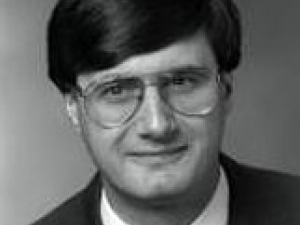
The September-October 2009 issue of Duke Magazine chronicles the work of Dan Gauthier, Chair of Duke Physics, in his search for technological applications of chaos. Possibilities include more efficient pacemakers for arrhythmic hearts and improved intruder detection sensors. Read more about the world of chaos at Duke Magazine Online. read more about Research Update - Gauthier Digs Into Chaos »
Two graduate students at Duke have recently been named recipients of prestigious research awards at Duke Physics. Seth Henshaw was named the latest recipient of the 2009 Newson Graduate Fellowship for his PhD thesis work at TUNL. Phillip Wu has been awarded the 2009 Fritz London Graduate Fellowship for his work in the field of low temperature physics. Henshaw Receives Newson Fellowship Seth Henshaw is the latest recipient of the Henry W. Newson Graduate Fellowship, established to honor the founder and… read more about Graduate Student News - Research Awards »

We haven’t seen a supernova in our galaxy since 1604. “We’re really due for one,” says Duke physicist Kate Scholberg. To make sure that scientists get the most out of the next event, Scholberg started the SuperNova Early Warning System (SNEWS), a program that will notify thousands of professional and amateur astronomers as the supernova begins. Scholberg studies neutrinos and she is particularly interested in those that are produced in supernovae. When a star explodes, neutrinos escape the conflagration first, even before… read more about Research Update - Duke Prof Sets Up Supernova Alert »

Duke alum Sheila Brown Bailey has spent the last 24 years working on solar cells at the NASA’s Glenn Research Center in Cleveland. “My job basically is to make a better solar cell, meaning one that is more efficient or that lasts longer or is cheaper to make,” she says. “Right now I’m doing some fundamental research in quantum dot solar cells.” She and her colleagues are using nanostructures called quantum dots to manipulate the width of the band gap in photovoltaic cells. “The name of the game in PV is… read more about Alumni Profile - Duke Alum Designs Better PV Cells at NASA's GRC »
On August 24, Professor Glenn Edwards left for the Curie Institute in Paris, France for a year-long sabbatical.In September Professor Moo-Young Han departs for one semester to teach at the College of Natural Sciences of the Seoul National University in Seoul, Korea. He will return for the start of the Spring semester of 2010.At the end of August, Professor Henry Greenside will leave for a semester-long sabbatical at Janelia Farm Research Campus, a biomedical research… read more about Sabbaticals »

The Research Experience for Undergraduates (or REU) program at the Triangle Universities Nuclear Laboratory (TUNL) is now in its tenth year of funding from the National Science Foundation. This program, lasting ten weeks, provides students with an introduction to graduate level research as they work with nuclear physics faculty from around the triangle. Explore photos of the TUNL REU program at Flickr! read more about TUNL Hosts 2009 REU Program »
Theoretical and experimental physicists at Duke are discovering surprising similarities between the behavior of matter at superhot temperatures (2 trillion degrees) and supercold temperatures (1/10 of a microdegree above absolute zero). To learn more, see these two articles by Monte Basgall about the work of John Thomas, Steffen Bass, and Berndt Mueller on the Duke Research website: Fire Meets Ice : Superhot And Supercold Remarkably Similar In The 'Fermion' WorldMelting Spacetime: Gold Atom Smashups… read more about Research Update: Superhot and Supercold »
Dr. Nicholas Buchler, from Rockefeller University, started August 1; Buchler has a joint appointment in the departments of Physics and Biology, and the Institute for Genome Science and Policy (IGSP).Dr. Ayana Holloway Arce, a Chamberlain Postdoctoral Fellow from the Lawrence Berkeley National Laboratory is a high-energy physicist and will start January 1, 2010.Dr. Jian-Guo Liu, from the University of Maryland, joined the faculty July 1; Liu has a joint appointment… read more about New Faculty »
Professor Henry Greenside has co-authored a graduate-level textbook called Pattern Formation and Dynamics in Nonequilibrium Systems. Greenside's co-author is Professor Michael C. Cross at the California Institute of Technology. As a member of Duke’s Center for Nonlinear and Complex Systems, Greenside has spent years teasing apart the secrets of nonequilibrium systems. Discovering the rules that govern nonequilibrium systems could lead to better prediction of weather… read more about Greenside's Textbook Hot off the Presses »
The 2009 Optical Society of America Conference in Hawaii In mid-July, Professor Daniel Gauthier, chair of the Duke Physics Department, and Joel Greenberg, a fourth-year PhD graduate student, traveled to Honolulu, Hawaii, to present papers at the Optics & Photonics Congress hosted by the Optical Society of America. Greenberg presented the paper, Superfluorescence in an Ultracold Vapor, about an aspect of the search for a nonlinear optical system activated by a single photon, and Gauthier presented Stored Light and… read more about Travel Notes: Gauthier and Greenberg to Hawaii »

The quest for understanding often leads physics researchers and students to the far corners of the world. This summer, Horacio Carias, graduate student at Duke Physics, spent five weeks in Cyprus and Israel studying electron tunneling. He participated in an international symposium, spent untold hours doing research, and still found time to ride a camel and visit the Pyramids. Carias, a third-year graduate student at Duke, is working on an interdisciplinary research thesis in theoretical and computational… read more about Travel Notes: Electrons, Pyramids, and Camels »
The Physics Department is starting a new communication program, using online media to communicate to the world about our scholarly activities. Over the next year we will be developing a collection of multi-media "stories" for a range of audiences with whom we wish to be in touch - prospective students, prospective faculty, and Department alumni, among others. We're always looking for good stories. If you're a member of the Duke Physics community, past or present, let us know what you're up to. Stay in touch,… read more about Welcome to Duke Physics News »